
Featured Posts
View all posts
The Michigan Historical Review Reviews
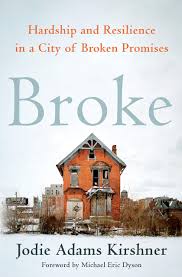
Broke: Hardship and Resilience in a City of Broken Promises

Jodie Kirshner Awarded Tillie Olsen Award
'Broke' Shortlisted
for J. Anthony Lukas Book Prize

Kirshner and 'Broke' Featured on BBC World

Kirshner Discusses 'Broke' on C-SPAN

Jodie Adams Kirshner Joins NYU Marron Institute
with Funding Support from the Kresge Foundation
Featured Press Posts
View all press posts
'Broke' Selected as New York Times Editors' Choice

'Broke'
How Detroit Residents Maneuvered The City's Bankruptcy
‘Broke’ Chronicles a City Out of Cash
and Awash in Desperation
Leader: Jodie Adams Kirshner

Jodie Adams Kirshner is a Research Professor at the NYU Marron Institute, where she launched and leads a new economic mobility program. Her work blends in-depth legal and policy analysis with human-centered storytelling to reveal the lived realities behind structural inequality in America. She has been widely published in major publications, including the New York Times, the Atlantic, the Financial Times, the Los Angeles Times, the Boston Globe, the American Prospect, the Hill, the Daily Beast, the Washington Monthly, Forbes, and the Christian Science Monitor. Jodie has been interviewed about her work in many diverse outlets, including NPR’s Morning Edition, the BBC, C-SPAN, the Aspen Institute, the American Academy of Arts and Sciences and the Hunt Institute.
Kirshner is also the author of Broke: Hardship and Resilience in a City of Broken Promises (St. Martin’s Press, 2019), a narrative nonfiction book chronicling Detroit’s bankruptcy ordeal and the effect it had on the most vulnerable. Broke was one of five finalists for the J. Anthony Lukas Award and was designated a New York Times Book Review Editor’s Choice. The book won the Tillie Olsen Award, was named a Michigan Notable Book, and received a starred review from Kirkus and favorable coverage in outlets including The New York Times and NPR’s Morning Edition. The research was supported by the Kresge Foundation.
Kirshner joined NYU from Cambridge University, in England, where she was a law professor, the deputy director of the LL.M. program and the Centre for Corporate and Commercial Law, and a fellow of Peterhouse College. From 2014-19 she taught a bankruptcy law seminar at Columbia Law School and authored the academic volume International Bankruptcy: The Challenge of Insolvency in a Global Economy (University of Chicago Press, 2018).
After receiving her undergraduate degree from Harvard, Kirshner studied both law and journalism at Columbia University and was a Fulbright Scholar at Oxford University. She completed postdoctoral fellowships at the London Business School and the Max Planck Institute for Comparative and International Law. Among other affiliations, she has served as a technical advisor to the Bank for International Settlements, is an elected member of the American Law Institute, a fellow of the American Bar Foundation and of the Salzburg Global Seminar, a member of the Century Association, and former term member of the Council on Foreign Relations. She is admitted to the New York Bar.
Kirshner’s current projects, supported by the ECMC, Kresge, Lumina, and Ascendium Foundations, include two forthcoming books for a general audience. One, The Small-Dollar Solution (The New Press, TBD) explores the impact of unexpected financial shocks on young adults and the limits of existing aid systems. The book will coin the term “microfunding” for small, emergency payments delivered quickly at the critical stage of late adolescence when individuals are most likely to break the cycle of poverty. Her other project documents people in the southern coalfields of West Virginia caught in the crosshairs of economic peril and promise as the old, coal-based energy economy transitions to a new, greener one. Her op-ed based on her initial work appeared in the Financial Times and was selected for its One Must-Read daily newsletter, while her feature article on the human and economic impacts of the end of solar subsidies in the Inflation Reduction Act appeared in the American Prospect.